▣Photo coming soon
You May Also Consider
Compare with these sandstones
RR cladding works with these.
RR Cladding · Random Rubble · Full Depth
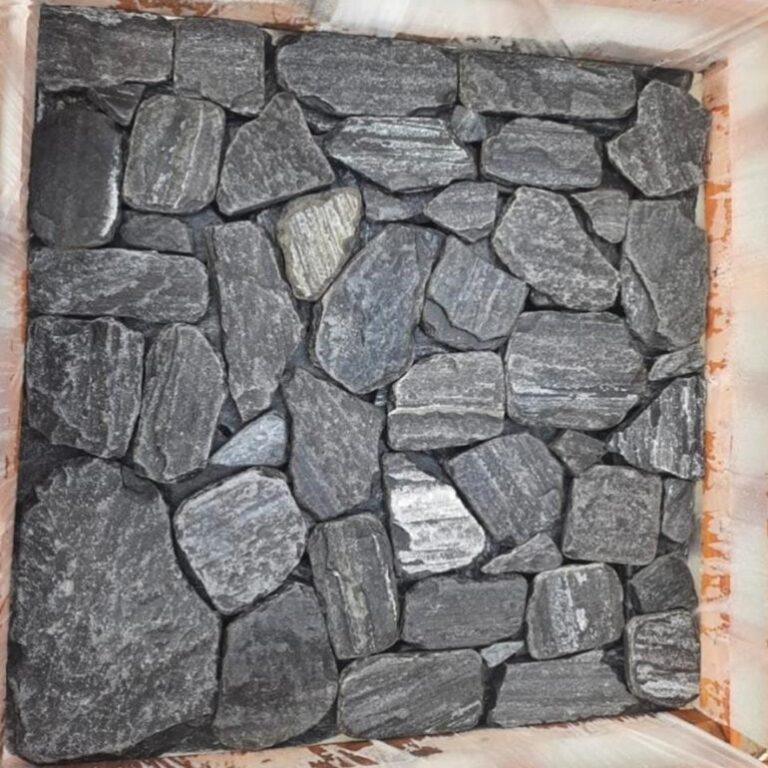
Random rubble cladding — angular natural stone, 4 to 12 inches, laid without a pattern. The oldest walling method there is, and still the most characterful.
Rubble stone is a selection of medium sized, angular natural stones, anywhere between 4 and 12 inches in size — laid random, coursed, or squared to suit the building.
About the Stone
Random rubble (RR) cladding is the oldest form of stone walling there is — angular natural stones, typically between 4 and 12 inches, laid without a regular pattern. Every field wall in Britain and every dry stone dyke in Ireland is random rubble. It predates the sawn, calibrated, machine-cut world by several thousand years and it still looks better than most of what replaced it.
The character comes from the irregularity. Because no two stones are the same, no two walls are the same, and the eye reads that as authentic in a way a repeating pattern never can. It also means RR is genuinely forgiving to lay: there is no course to keep level, no joint to line up, no cut that has to be exact. What matters is that each stone sits solidly on the two beneath it.
We supply RR cladding in our full stone range, graded to size, for retaining walls, boundary walls, building facades, fire pits and garden features. It can be laid random for maximum rusticity, brought to courses at intervals for a more ordered look, or roughly squared for a tighter architectural face — the same material, three quite different results.
Sold by weight. Expect roughly 25–35 sq ft of wall face per ton, depending on the stone and how tightly it is laid. Order 10% extra — on rubble, you will use it.
A few honest notes that will save you real trouble later.
Every stone sits on two below it. This is the one rule of rubble walling and it has not changed in three thousand years. A stone bridging a joint is stable; a stone sitting in a joint is a wall waiting to bulge. Get this right and everything else forgives itself.
Sort before you start. Lay the delivery out where you can see it. You want the largest stones at the base, the flattest for coursing points, the squarest for corners and ends, and the awkward ones buried in the middle. Sorting for an hour saves a day.
Batter the face on retaining walls. A retaining wall should lean back into the bank by roughly 1 in 6. Vertical retaining walls fail; battered ones use the weight of the bank to hold themselves together. This is not optional on anything above knee height.
Order 10% extra — and you will use it. Rubble has more waste than any other format because the whole point is selecting pieces that fit. Some stones will simply never find a home in the wall.
Battered back into the bank — weight doing the work.
Field walls and garden boundaries with genuine character.
Rubble takes heat and irregularity better than any cut stone.
Random, coursed or squared — three looks from one material.
Care & Maintenance
Almost none. Brush down occasionally. In damp or shaded positions an annual wash keeps organic growth from establishing in the joints, though on a rubble wall moss and lichen genuinely improve the look and most people leave them.
Avoid high-pressure washing, which drives water deep into the joints and can loosen pointing. Check the wall head and the coping periodically — water getting into the top of a rubble wall is how they fail, not water on the face.
Random rubble cladding — angular natural stones, typically 4 to 12 inches, laid without a regular pattern. It is the oldest form of stone walling there is: every traditional field wall and dry stone dyke is random rubble.
Roughly 25-35 square feet of wall face per ton, depending on the stone and how tightly it is laid. Order 10% extra — rubble has more waste than any other format because the whole point is selecting pieces that fit.
Same material, three results. Random has no courses at all — the most rustic and most forgiving. Coursed is brought to level courses at intervals, more ordered but still natural. Squared uses roughly squared pieces for a tighter, more architectural face.
Yes, and it is one of its best uses. But batter the face back into the bank by roughly 1 in 6. Vertical retaining walls fail; battered ones use the weight of the bank to hold themselves together. This is not optional above knee height.
It is forgiving in some ways and unforgiving in one. There is no course to keep level and no joint to line up, so it tolerates imprecision. But every stone must sit on two below it — a stone sitting in a joint rather than bridging one is a wall waiting to bulge.
Our full range, graded to size. Tell us the stone, the size grade and the tonnage, and whether you are laying random, coursed or squared — the grading differs.
Tell us the thickness, quantity and destination — we'll come back with USD/sqft pricing and confirmed lead times. No agents in between.
RR cladding works with these.
Speak to our team for pricing, samples, MOQ details and shipping options to your country. Direct from India since 1996.