▣Photo coming soon
You May Also Consider
Compare with these sandstones
Mosaics work with these.
Stone Mosaics · Mesh Backed
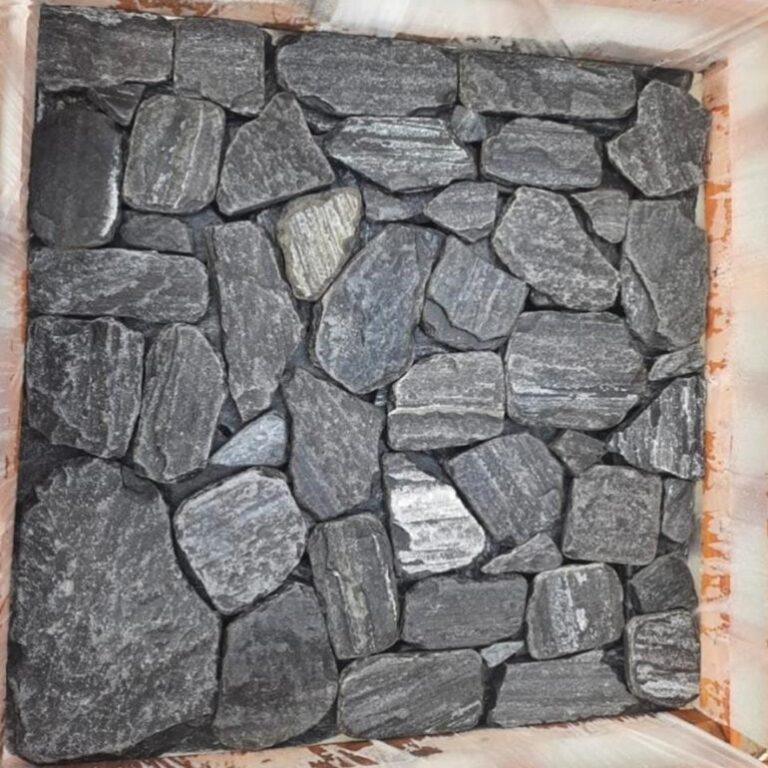
Mesh-backed mosaic panels in natural stone — brick bond, random, herringbone and pebble. All the detail of hand-set mosaic, laid at the speed of a tile.
Mesh-backed panels that go up like tile and read like hand-set stone. For feature walls, splashbacks, bathrooms and pool linings.
About the Stone
Stone mosaics are small natural stone pieces, mounted on a mesh backing in panels. That backing is the whole point: it gives you the intricacy of hand-set mosaic with the installation speed of a tile. A pattern that would take a craftsman days to set piece by piece goes up in an afternoon.
We produce them in brick bond, random, herringbone, basketweave and pebble layouts, in our full stone range — and in mixed-stone panels where the colour variation becomes the design. Common uses are feature walls, splashbacks, bathroom walls and floors, pool linings and shower trays, though they work equally well as a border or inlay set into larger paving.
The practical advantage over large-format stone is scale. A mosaic panel absorbs a curved or uneven surface that a big slab simply cannot — which is why they dominate in bathrooms, around columns, and on anything with a radius. The practical disadvantage is grout: a mosaic has enormously more joint length than a slab, and the grout choice matters more than the stone.
Supplied as mesh-backed panels, boxed. Tell us the pattern, the stone and the area — we will confirm panel size, coverage per box and lead time.
A few honest notes that will save you real trouble later.
Grout is the decision, not the stone. A mosaic has many times the joint length of a slab, so grout is a much larger share of what you actually see. Get the colour right and the mosaic reads as one surface; get it wrong and you have made a grid. Sample it before you commit — grout dries lighter than it looks wet.
Seal before you grout on porous stone. Sandstone and limestone mosaic will absorb grout pigment straight into the face, and it does not come out. A pre-grout sealer coat is standard practice and skipping it is a permanent mistake. Dark grout on pale stone is where this bites hardest.
The substrate must be flat and sound. Mosaic follows whatever is underneath it. It absorbs curves beautifully but it telegraphs bumps and dips just as faithfully — a lumpy wall gives you a lumpy mosaic, and the small format makes it more obvious, not less.
Mind the panel edges. The join between panels should be indistinguishable from the joints within a panel. Set them consistently and stagger the panel seams — a visible grid of panel edges is the classic mosaic failure.
The intricacy of hand-set stone at tile speed.
Walls, floors and shower trays — small format handles the falls.
Mosaic absorbs the curves a slab cannot.
Kitchen splashbacks, and inlay borders in larger paving.
Care & Maintenance
Clean with a mild, pH-neutral detergent. Never use acidic cleaners — on limestone mosaic the damage is permanent, and acid attacks cement grout on any stone. That is worth emphasising here because mosaics have so much more grout than any other format.
Reseal porous stone mosaic periodically, particularly in wet areas. The stone is only part of the surface; the grout is porous too, and it is usually the grout that discolours first. Keeping both sealed is what keeps a mosaic looking new.
Small natural stone pieces mounted on a mesh backing in panels. The backing means a pattern that would take a craftsman days to set piece by piece goes up in an afternoon — you get hand-set intricacy at tile installation speed.
Brick bond, random, herringbone, basketweave and pebble, in our full stone range. We also do mixed-stone panels where the colour variation becomes the design, and bespoke patterns to order.
Because there is so much more of it. A mosaic has many times the joint length of a slab, so grout is a much larger share of what you actually see. Get the colour right and it reads as one surface; get it wrong and you have made a grid. Always sample it — grout dries lighter than it looks wet.
On porous stone, yes — always. Sandstone and limestone mosaic will absorb grout pigment straight into the face and it does not come out. A pre-grout sealer coat is standard practice. This matters most with dark grout on pale stone.
Yes, and it is one of its main advantages. The small format absorbs curves and radii that a large slab simply cannot — which is why mosaic dominates in bathrooms, around columns and on pool linings.
Yes, if the stone is frost-resistant and both stone and grout are sealed. Bear in mind the joint length works against you outdoors — more grout means more places for water to get in, so sealing matters more than it does on paving.
Tell us the thickness, quantity and destination — we'll come back with USD/sqft pricing and confirmed lead times. No agents in between.
Mosaics work with these.
Speak to our team for pricing, samples, MOQ details and shipping options to your country. Direct from India since 1996.