Ash Grey Limestone · Ash Grey · Dove Grey
Slate grey, softly aged.
A uniform slate-grey with subtle white speckles and an orange-peel texture — hard-wearing, heat-resistant and oil-resistant. Quarried.
Ash Grey Limestone · Ash Grey · Dove Grey
A uniform slate-grey with subtle white speckles and an orange-peel texture — hard-wearing, heat-resistant and oil-resistant. Quarried.
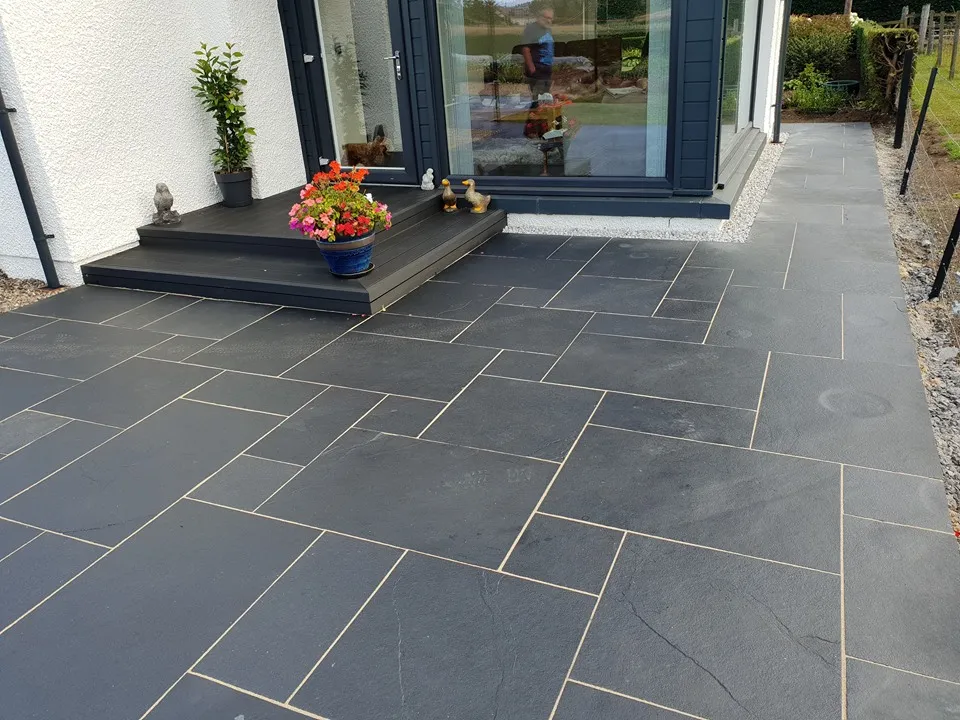
A uniform slate-grey hue with subtle brown streaks or white speckles, complemented by a tactile orange-peel texture that gives it a non-slip, elegant finish.
About the Stone
Ash Grey Limestone — also known as Ash Grey, Dove Grey, Andhra Grey or simply South India Grey — is excavated from the mines of the Ash district, southern India. It presents a uniform slate-grey hue with subtle brown streaks or white speckles, and a tactile “orange peel” texture that gives it both an elegant finish and genuine non-slip performance.
It is a sedimentary limestone composed of calcium carbonate in the form of calcite and aragonite. Two properties set it apart: it is notably resistant to high temperatures, and it is oil-resistant — which is why it is specified so often for flooring in commercial complexes, airports, hospitals, railway stations and public parks, as well as domestic kitchens. It is also easy to cut and reshape, so it adapts to whatever an architectural design demands.
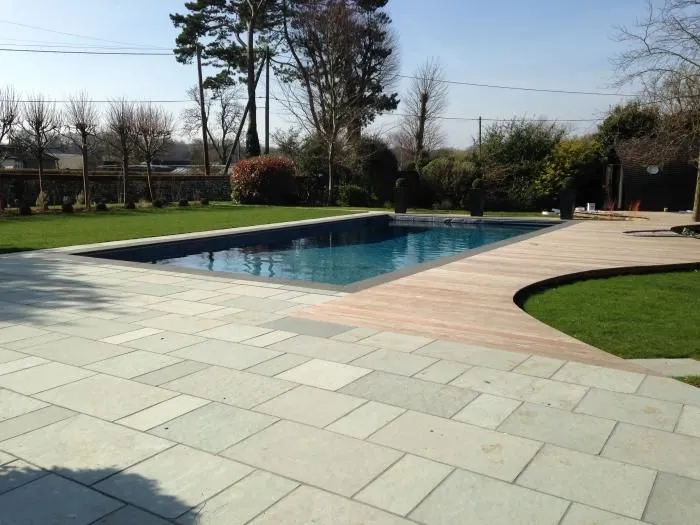
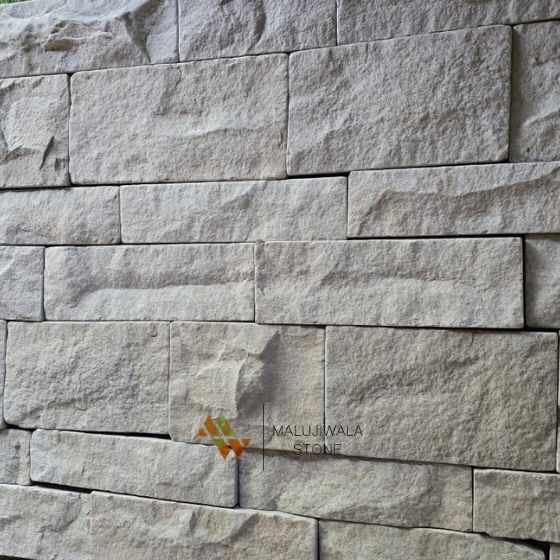
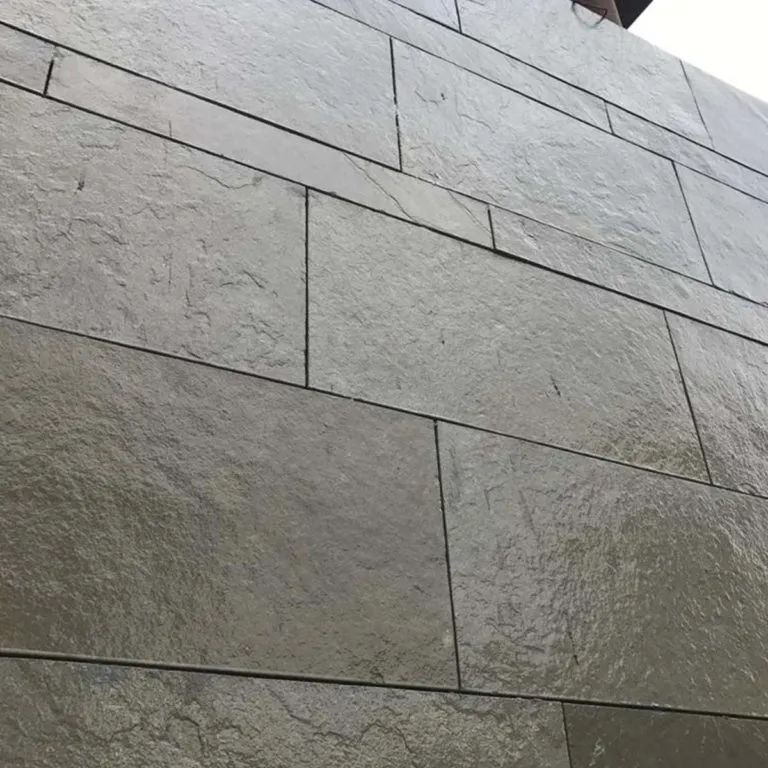
Its rough texture is the point. Where Kota Blue and Tandur Grey are chosen for flatness, Ash Grey is chosen for that tactile surface — it adds grandeur to a wall elevation in a way smoother stones cannot. That is why its most common use is wall cladding, though it performs equally well as landscape paving, pool coping, sills, mosaics and interior flooring.
Available in 22mm, 28mm and 30mm thickness with 22mm calibration. Common tile sizes 600×400 and 600×600mm; cladding thicknesses 2, 3, 4 and 5cm. Custom cuts to specification.
Limestone behaves differently to sandstone. A few honest notes that will save you real trouble later.
Never use acid on limestone. This is the one rule that matters most. Limestone is calcium carbonate, so acidic cleaners and patio cleaners react chemically with the stone itself — the damage is permanent and irreparable, not a stain you can lift. If you take nothing else from this page: pH-neutral only, on Ash Grey and on every limestone.
Use a slurry primer underneath. Paint a slurry primer onto the back of each slab before bedding. It prevents salt and mineral staining leaching up from the mortar bed — a common cause of patchy discolouration that appears weeks after laying and cannot be reversed.
Mix your crates. Sort through all crates on arrival and draw evenly from each so colour variation is distributed across the whole area. Set aside any slabs with heavier chipping or markings to use as cuts.
Sawn edges chip — that is normal. Limestone paving has machine-sawn edges rather than hand-dressed ones. Small chips to corners, edges or the back are an unavoidable result of production and transport, and are not a defect. Once laid and pointed, they are almost never visible.
Order 10% extra. Standard for any natural stone — covers cuts, breakage and undercounted measurements.
Its signature application — rough texture that adds depth to interior and exterior walls.
Oil-resistant and heat-resistant — ideal for kitchens, homes and offices.
Patios, walkways and garden paths with genuine slip resistance.
Airports, hospitals, stations, malls and parks — built for heavy traffic.
Care & Maintenance
Sweep with a soft broom and wash occasionally with a mild, pH-neutral detergent. Never use an acid-based cleaner on Ash Grey, either as a wash or to shift mortar stains — the chemical reaction between acid and limestone permanently damages the surface of the stone. There is no fixing it afterwards.
Sealing is recommended. A breathable, impregnating sealer helps resist staining and organic growth through wet British winters while letting the stone breathe. Reseal every two to four years depending on exposure.
Yes. The same stone is sold as Ash Grey, Ash Grey, Dove Grey, Andhra Grey, South India Grey and simply Grey Limestone. It all comes from the Ash district.
Texture, mainly. Both are southern Indian grey limestones, but Ash Grey has a notably rougher, tactile orange-peel surface where Tandur Grey is flatter. That roughness is why Ash Grey is the go-to for wall cladding, while Tandur Grey is more often chosen for flat paving.
No. The orange-peel texture gives it genuine natural grip — it is described as non-slippery and is also oil-resistant, which is why it is specified for commercial kitchens, pool surrounds and high-traffic public floors.
Yes — it is one of its defining properties. Ash Grey resists high temperatures, which makes it suitable for hearths, kitchens and hot-climate exteriors as well as UK gardens.
Never. It is a limestone, so acid reacts chemically with the calcium carbonate and permanently damages the surface. Use pH-neutral cleaners only.
22mm, 28mm and 30mm for paving, with 22mm calibration for easy laying. For cladding we supply 2cm, 3cm, 4cm and 5cm. It cuts and reshapes easily, so custom sizes are straightforward.
Tell us the thickness, quantity and destination — we'll come back with pricing and confirmed lead times. No agents in between.
These are the alternatives UK buyers most often weigh against Ash Grey.
Speak to our team for pricing, samples, MOQ details and shipping options to your country. Direct from India since 1996.