Rock Boulders · Natural & Drilled
Natural boulders from 10 inches upward — for waterfalls, accent features, seating, retaining and erosion control. Each one unique, each one sourced individually.
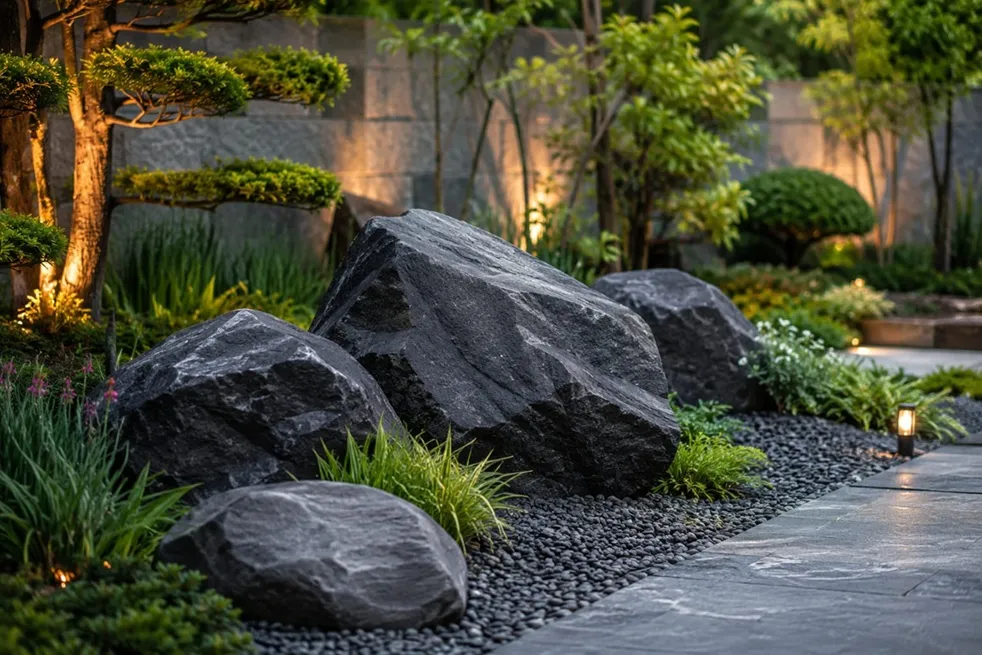
Landscape boulders are large natural rocks, typically 10 inches or more in diameter, used to create bold and dramatic visual impact in outdoor designs.
About the Stone
Landscape boulders are large natural rocks, typically 10 inches or more in diameter, used to create bold and dramatic visual impact in outdoor designs. They are ideal for waterfalls, accent features, benches, diving rocks, soil retention and more. Each boulder is uniquely shaped and sourced individually for natural beauty and durability — you are not buying a product line, you are buying a specific rock.
Beyond aesthetics, boulders do real work. Their weight and stability prevent soil erosion, especially on slopes or in areas with heavy rainfall. Strategically positioned, they improve drainage and redirect water flow without compromising the design. Landscapers often combine boulders with gravel, river rocks or smaller pebbles to stabilise terrain while maintaining a clean, sophisticated appearance.
The honest advice on using them: fewer, larger boulders always look better than more, smaller ones. A garden with three well-placed substantial rocks reads as landscape. The same garden with fifteen medium rocks reads as a rockery, and rockeries went out with the 1970s for good reason. Bury the base of each boulder by roughly a third — a rock sitting on top of the soil looks delivered; a rock emerging from it looks like it was always there.
Sold individually or by weight. Boulders are unique by nature — tell us the size range, the stone and the quantity, and we will send photographs of actual pieces before dispatch rather than a catalogue image.
A few honest notes that will save you real trouble later.
Bury a third of it. This is the single difference between a boulder that looks placed and one that looks delivered. A rock sitting proud on the soil reads as an object; a rock with its base buried reads as geology. Dig the hole before the boulder arrives.
Plan the machine access first. A 2,000 lb boulder is not going through a side gate. Confirm what plant can reach the position — and confirm what the route can take. Wheeled plant on a new lawn does more damage than the boulder is worth.
Fewer and larger, always. Three substantial boulders will outperform fifteen medium ones every time. Group them in odd numbers, vary the sizes, and set them with the grain running consistently — in nature, rock strata run the same direction. Setting boulders at random angles is what makes a rockery look artificial.
Compact under the base on soft ground. A heavy boulder on soft soil will settle unevenly over a winter, and a boulder that has tipped is a genuine job to correct. A compacted bed under the buried section prevents it.
The classic use — stone and moving water, drilled and plumbed to order.
Weight and stability on slopes and areas of heavy rainfall.
A dramatic focal point that costs nothing to maintain.
Flat-topped pieces cut for informal garden seating.
Care & Maintenance
None, essentially. A boulder is a rock — it has survived several million years of weather already and your garden will not trouble it. Hose it down occasionally if you want the colour back.
The only thing worth watching is settlement. If a boulder has tipped noticeably after a wet winter, the base was not compacted properly. It is worth correcting early, while it is a small job rather than a machine job.
Typically 10 inches or more in diameter, running from around 500 lbs up to 2,000 lbs and beyond. Each boulder is uniquely shaped and individually sourced, so we work to a size range rather than an exact dimension.
Bury roughly a third of the height. A rock sitting on top of the soil looks delivered; a rock emerging from the ground looks like geology. Group them in odd numbers, vary the sizes, and set the grain running consistently — in nature, rock strata run the same direction.
Fewer than you think. Three substantial boulders will always look better than fifteen medium ones. A garden with a few well-placed large rocks reads as landscape; the same garden with lots of medium rocks reads as a rockery.
Yes. We drill and cut to specification. A boulder fountain combines the timeless look of stone with moving water and makes a dramatic focal point — it is one of the most requested things we do with boulders.
Yes, genuinely. Their weight and stability prevent soil erosion, particularly on slopes or in areas with heavy rainfall. Positioned strategically they improve drainage and redirect water flow. Landscapers often combine them with gravel or pebbles to stabilise terrain.
Yes, and you should. Boulders are unique by nature, so we photograph the actual pieces before dispatch rather than sending a catalogue image. Tell us the size range and stone and we will show you what we have.
Tell us the thickness, quantity and destination — we'll come back with USD/sqft pricing and confirmed lead times. No agents in between.
Boulders work with these.
Speak to our team for pricing, samples, MOQ details and shipping options to your country. Direct from India since 1996.