Blog · Paving Notes
Split Face Basalt Cobbles with Sawn Edges
Black basalt setts with a natural split top and machine-sawn sides and base — the look of an old cobbled street, laid with the accuracy of a modern paver.
- 4×4inSize, approx. 100 mm
- 40–50mmThickness
- 9/sq ftPieces, approx.
- ₹12/pieceFrom, + GST
A cobbled drive is one of the few surfaces that looks better the longer it is down. The difficulty has always been laying it. Fully hand-split cobbles vary in height and shape, so every piece has to be packed and levelled on site.
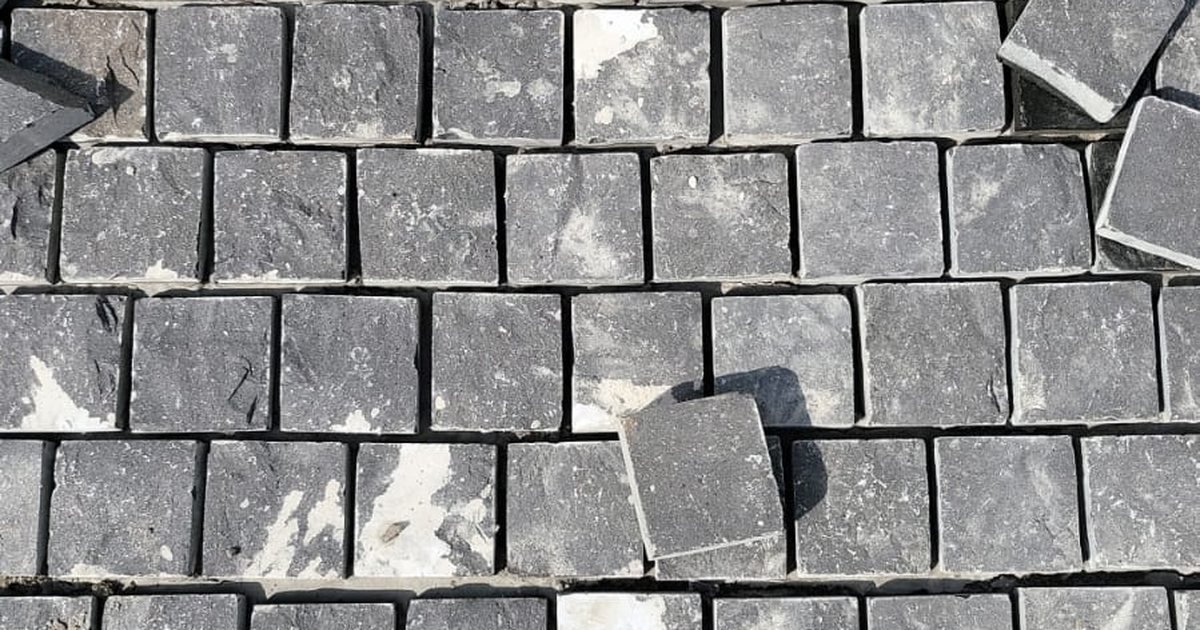
Split face cobbles with sawn edges solve that. The stone is split only on the face you walk on, so the surface keeps the rough, natural grain of black basalt. The four sides and the base are cut on a saw, so the pieces are square, consistent in thickness and quick to set out in straight lines. In the close-up below you can see both finishes on every piece: smooth, flat sawn sides under a rough split top.
Basalt is a dense volcanic rock — cooled lava — which is why it is so dark and so hard-wearing. Ours comes from India’s Deccan region and is cut in our own units. See the full range on our Black Basalt Cobbles page, or every finish on the Black Basalt page.
The texture of a hand-split cobble, the setting-out of a sawn paver.
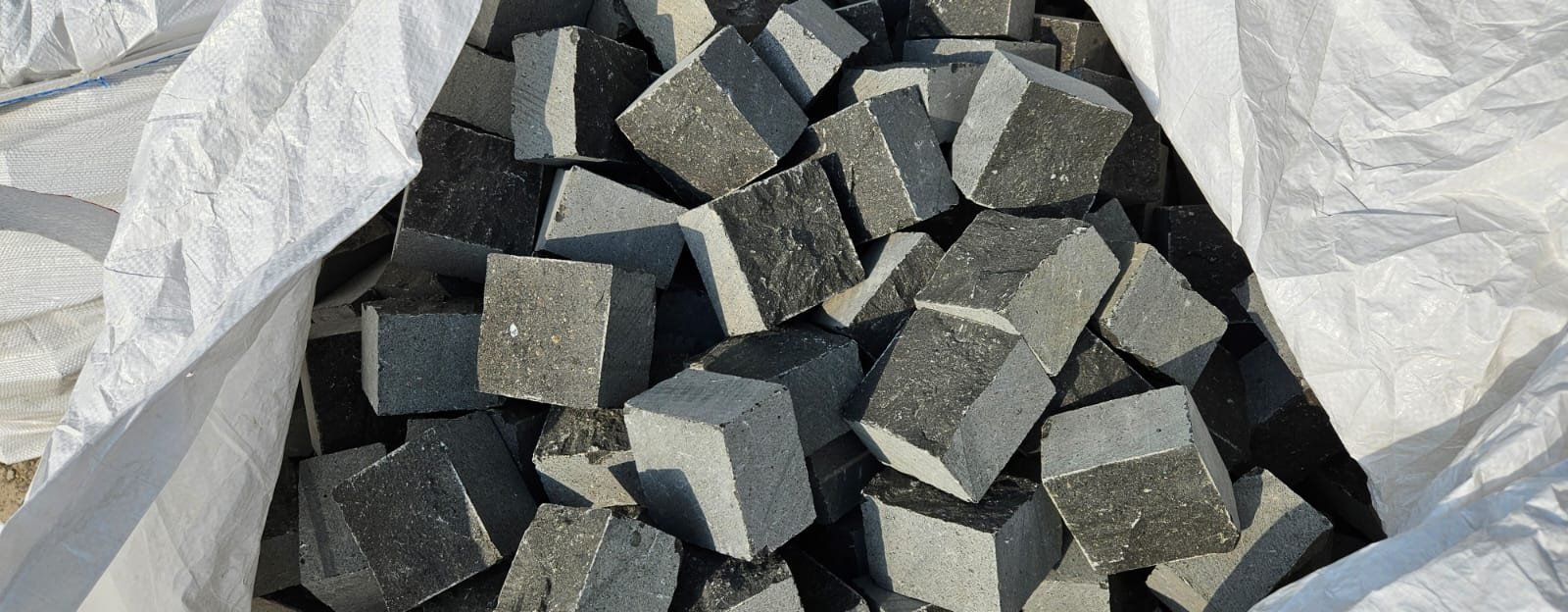
Split on top, sawn on five sides
One stone, two finishes: a natural split face for the surface, machine-sawn edges and base for the fit.
Which faces are split, which are sawn
How it is laid
| Product | Split Face Basalt Cobbles, sawn edges |
|---|---|
| Stone | Black basalt (igneous), Deccan region, India |
| Top surface | Natural split face |
| Edges | Machine sawn, all four sides |
| Base | Machine sawn, flat |
| Size | 4 × 4 inch (approx. 100 × 100 mm) |
| Thickness | 40 to 50 mm |
| Coverage | Approx. 9 pieces per sq ft (about 97 per m²) |
| Pieces per tonne | Approx. 750 |
| Price | From ₹12 per piece + GST (India) · export quoted FOB Mundra |
A family home in Fazilka, Punjab
Photographed mid-installation, before the joints were pointed and the surface washed down.
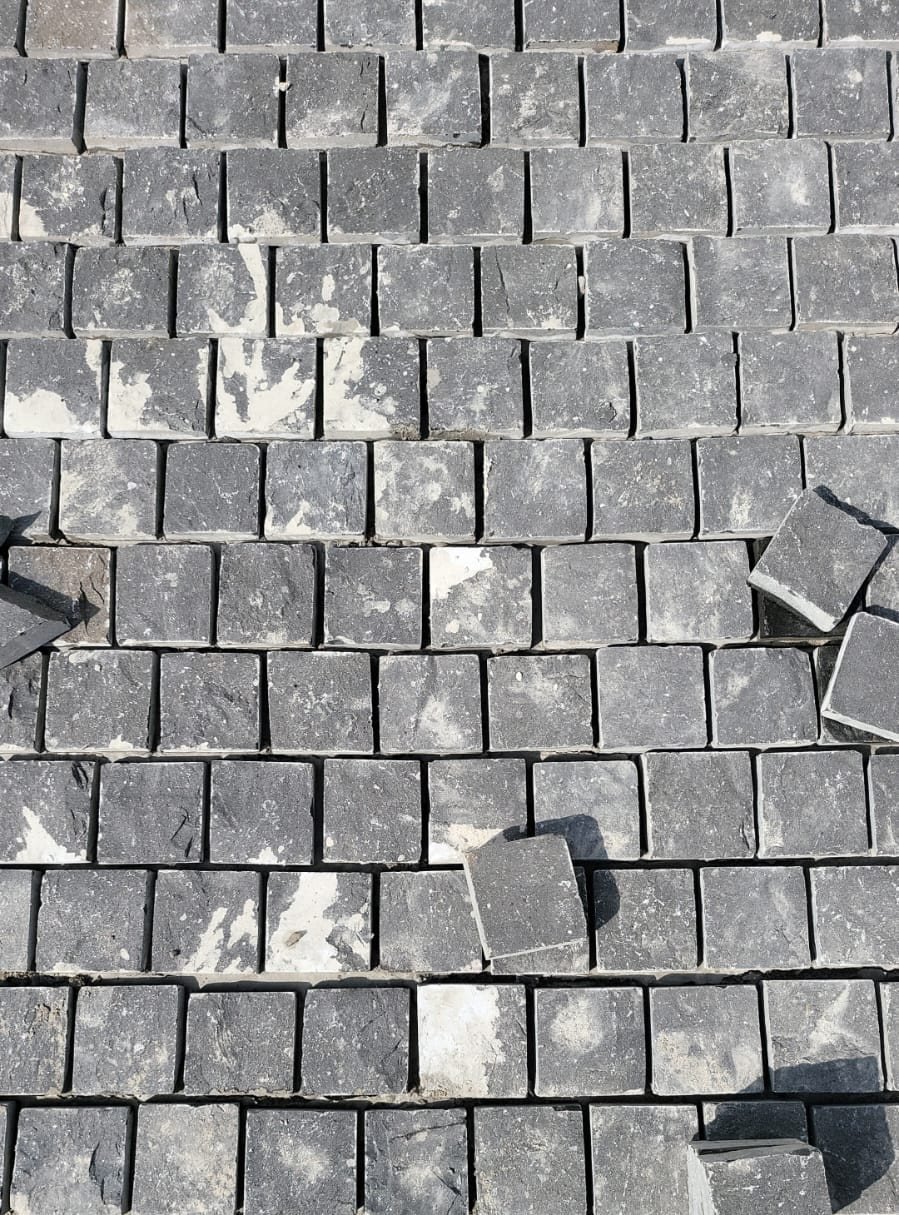
The cobbles here are laid in straight courses, each row offset from the one before. This running-bond pattern spreads the load of a car across the joints and hides the small size differences natural stone always has. Because every edge is sawn, the joints stay narrow and even across the whole drive.
Look closely and no two tops are the same, yet the surface reads as one calm, dark field. The pale patches on some stones are cement slurry from laying. It comes off with a wash before it dries, which is why cleaning as you go matters on black stone.
How to lay split face basalt cobbles
The method for driveways, car porches and courtyards.
- Dig out and build the sub-base. Excavate and lay a compacted sub-base of MOT Type 1 or equivalent crushed stone: about 100 mm for a path, 200 mm for a driveway, and 250 mm on clay soil.
- Set the falls. Give the surface a gentle slope away from the house so rainwater runs off.
- Spread the mortar bed. Lay a 30–40 mm semi-dry bed of 4:1 sand and cement, one working area at a time.
- Place the cobbles. Set each cobble sawn base down, split face up. Keep the rows straight and offset each row by half a cobble.
- Tap to level. Use a rubber mallet and a straight edge to bring the tops to one level, leaving 8–10 mm joints.
- Point the joints. Fill the joints with mortar once the bed has set, and top them up later if they wash out.
- Clean straight away. Wash off cement slurry before it dries — dried cement leaves grey patches on black stone.
How many cobbles do you need?
Area in sq ft × 9, plus 10% for cuts and breakage.
For a 500 sq ft driveway: 500 × 9 = 4,500 pieces, plus 10% = 4,950 pieces. At about 750 pieces per tonne, that is roughly 6.6 tonnes. At the starting rate of ₹12 per piece, the stone comes to about ₹59,400 + GST before freight.
- 100 sq ft — about 990 pieces, 1.3 tonnes
- 250 sq ft — about 2,475 pieces, 3.3 tonnes
- 500 sq ft — about 4,950 pieces, 6.6 tonnes
- 1,000 sq ft — about 9,900 pieces, 13.2 tonnes
Send us your area and city or country, and we will confirm the exact quantity before you order.
Before you order
What are split face basalt cobbles?
They are small square blocks of black basalt, a dense volcanic stone. The top face is split naturally, so it keeps a rough, textured grain. The four edges and the base are machine-sawn, so each piece is square and sits flat.
How are they different from hand-cut cobbles?
Hand-cut cobbles are split or chiselled on every face, so their shape and height vary and each one has to be packed and levelled on site. Sawn edge cobbles keep the natural split top but have straight sides and a flat base, which makes laying faster and joints neater.
What size are split face basalt cobbles?
Our standard size is 4 × 4 inch (about 100 × 100 mm), 40 to 50 mm thick. For a different size or thickness, send us your drawing and we will confirm what we can supply.
Are basalt cobbles strong enough for a driveway?
Yes. Basalt cobbles are suited to heavy traffic when they are laid on a mortar bed over a properly compacted sub-base — about 200 mm for a driveway, or 250 mm on clay soil.
Which way up do sawn edge cobbles go?
Sawn base down, split face up. The flat sawn base is what lets each cobble bed evenly on the mortar.
How many cobbles do I need per square foot?
Allow about 9 pieces of 4 × 4 inch cobbles per square foot, plus 10% extra for cuts and breakage. One tonne holds roughly 750 pieces.
How much do split face basalt cobbles cost?
In India they start from ₹12 per piece + GST. The final rate depends on quantity and delivery location. Export orders are quoted FOB Mundra on request.
How do I clean cement stains off basalt cobbles?
Wash cement slurry off while it is still wet. For routine cleaning use a soft broom and a pH-neutral wash, and keep any jet wash at low pressure (under 1,500 PSI). Avoid acidic cleaners.
Do you export basalt cobbles?
Yes. We ship FOB Mundra in about two weeks, CIF in four weeks or more, and offer door delivery to the UK and USA. Samples can be shipped worldwide.