Blog · Paving Notes
Stone Quartzite Crazy Pattern
Hand-fitted, irregular quartzite paving cut 30 to 50 mm thick, in pieces up to four feet across. A floor that is composed rather than laid — and built to outlast the house it leads to.
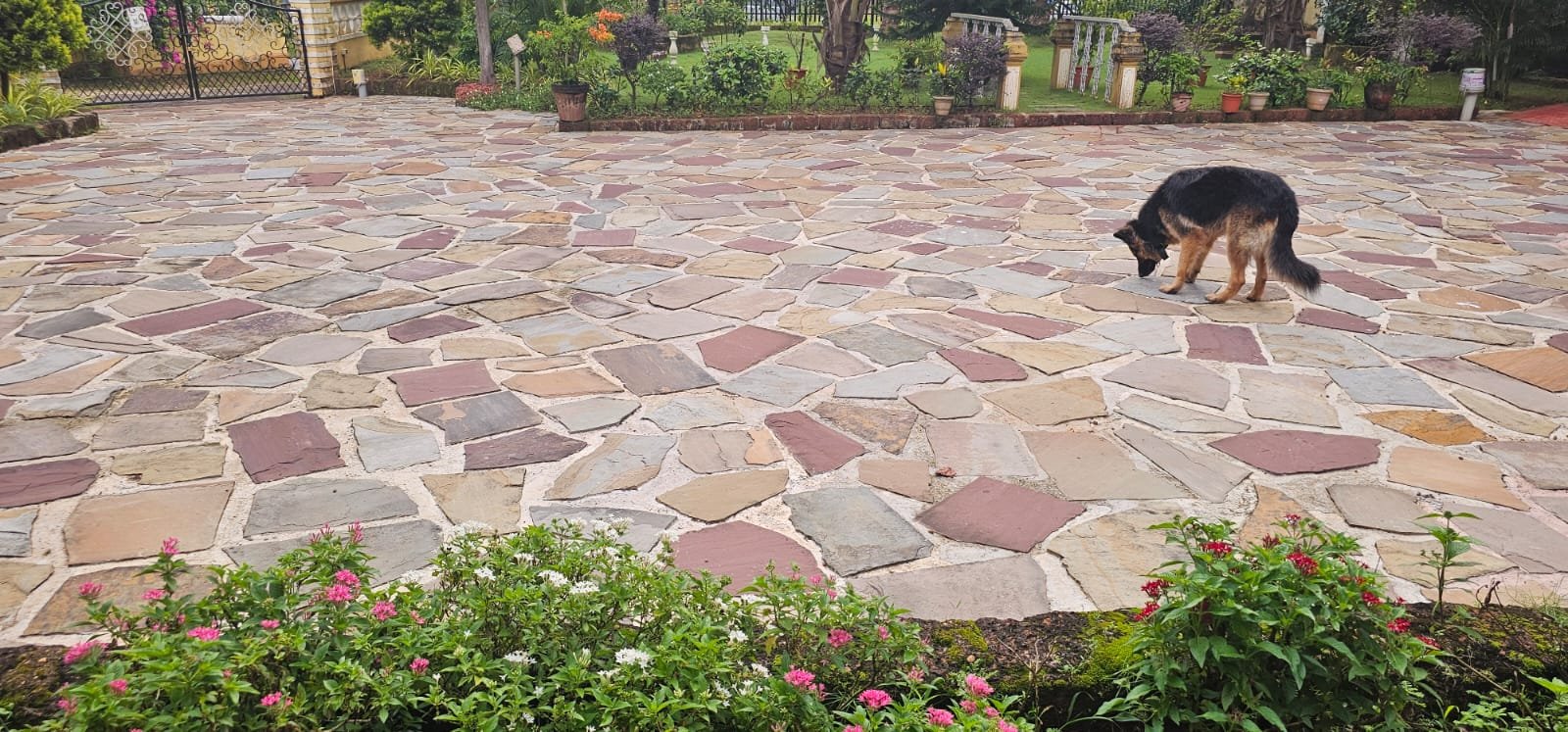
- 30–50mmThickness
- 1–4ftPiece size, random
- 6MohsSurface hardness
- 0.15%Water absorption
Crazy pattern is the oldest way to pave with stone, and still the most personal. Every piece is a natural, irregular slab; every joint is decided by hand on site. No two pieces are alike, so no two floors are alike — the drive in these photographs exists exactly once.
What makes this one different is the stone. Quartzite begins as sandstone and is then recrystallised by heat and pressure deep in the earth, until its quartz grains fuse into a dense, interlocking mass. That history is why it is hard, why it barely takes in water, and why its colours — rose, plum, slate-grey, ochre and sage, all in a single mix — sit inside the stone rather than on its surface.
We cut Stone Quartzite Crazy Pattern generously: 30 to 50 mm thick, with pieces running from about one foot to four feet across. The thickness gives it the body for driveways and forecourts; the large pieces let the pattern read as calm and architectural rather than busy.
Thick enough to carry a car. Beautiful enough to stop in the doorway and look at.
Strength you can measure
Typical values for the stone, each against its ASTM test method — with what the number means underfoot.
A dense, solid stone. Laid at 30–50 mm it weighs roughly 80–133 kg per square metre — real mass that sits still in its bed.
Ten kilograms of stone takes up only about 15 g of water. Less water in the stone means less to freeze, less to stain and less for moss to grow on.
Equal to roughly 1.19 tonnes pressing on a single square centimetre before the stone gives way — far beyond anything a car or a crowd will ask of it.
The bending (tensile) strength of the stone — measured in its weakest, saturated state. High resistance to cracking where pieces span small hollows in the bed.
Harder than glass and a steel blade. Grit, footwear and garden furniture will not readily scratch the surface — it keeps its face for decades.
- Frost
- Weathering
- Heat & cold cycles
- Salinity
- Acids
- Alkalis
Suited to the full range of indoor and outdoor work — coastal gardens, pool surrounds, monsoon climates and cold winters alike.
Values are typical results for the stone tested to the ASTM methods shown; natural stone varies from block to block.
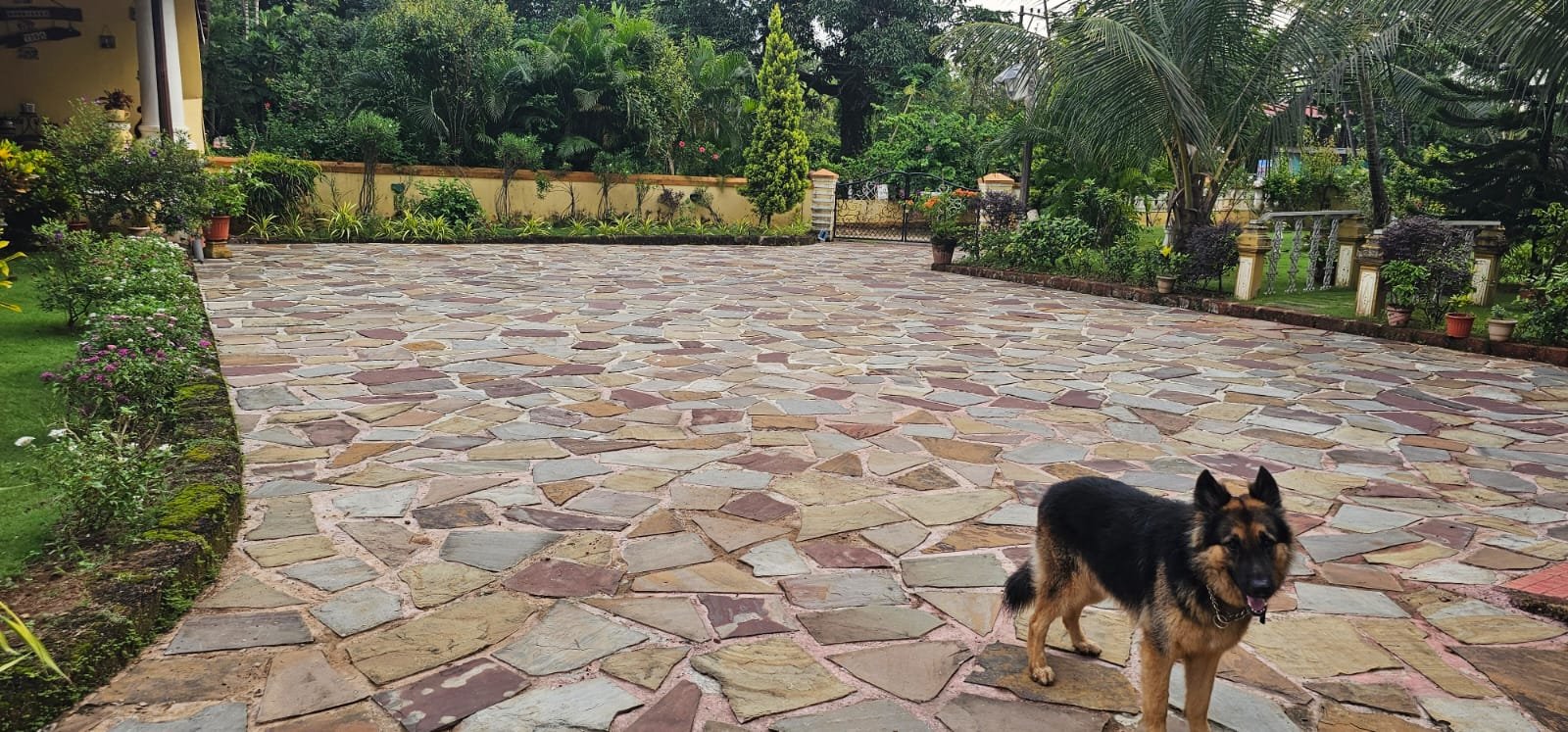
Cut thick, laid to last
Bedded in mortar on a concrete base, with joints pointed by hand.
How it is laid
Random, 1 ft to 4 ft
| Product | Stone Quartzite Crazy Pattern |
|---|---|
| Pattern | Crazy — random, irregular natural-edged pieces |
| Thickness | 30 to 50 mm |
| Piece size | Random, approx. 1 ft to 4 ft (305 to 1,220 mm) across |
| Colour | Multi-tone: rose, plum, slate-grey, ochre and sage in one mix |
| Weight, laid | Approx. 80 to 133 kg per m² (7.4 to 12.3 kg per sq ft), by thickness |
| Use | Indoor and outdoor |
Before you specify
What is crazy pattern paving?
Crazy pattern (also called crazy paving or flagstone paving) is a floor of irregular, natural-edged stone pieces fitted together by hand, with mortar joints between them. No two pieces are alike, so no two floors are alike.
How thick is it, and how big are the pieces?
Pieces are 30 to 50 mm thick and range from about 1 ft to 4 ft (roughly 305 to 1,220 mm) across. Laid, the stone weighs roughly 80 to 133 kg per square metre depending on thickness.
Can it be used on a driveway?
Yes. At 30 to 50 mm it has the thickness for vehicle areas when it is bedded in mortar on a concrete base. For areas that take cars, choose the thicker end of the range and have the base designed for the load.
Will it scratch or stain easily?
Its Mohs hardness of about 6 puts it harder than glass and steel, so everyday grit and footwear will not readily scratch it, and water absorption of around 0.15% by weight means very little liquid is taken into the stone.